

Most businesses still use AI the same way they used Google in 2005. Open a window, type a question, get an answer, close the tab. Every session starts from scratch. No memory. No continuity. No real autonomy.
That model is ending. And the companies that recognize it early will have a measurable operational advantage over those that don't.
From chat window to digital workforce
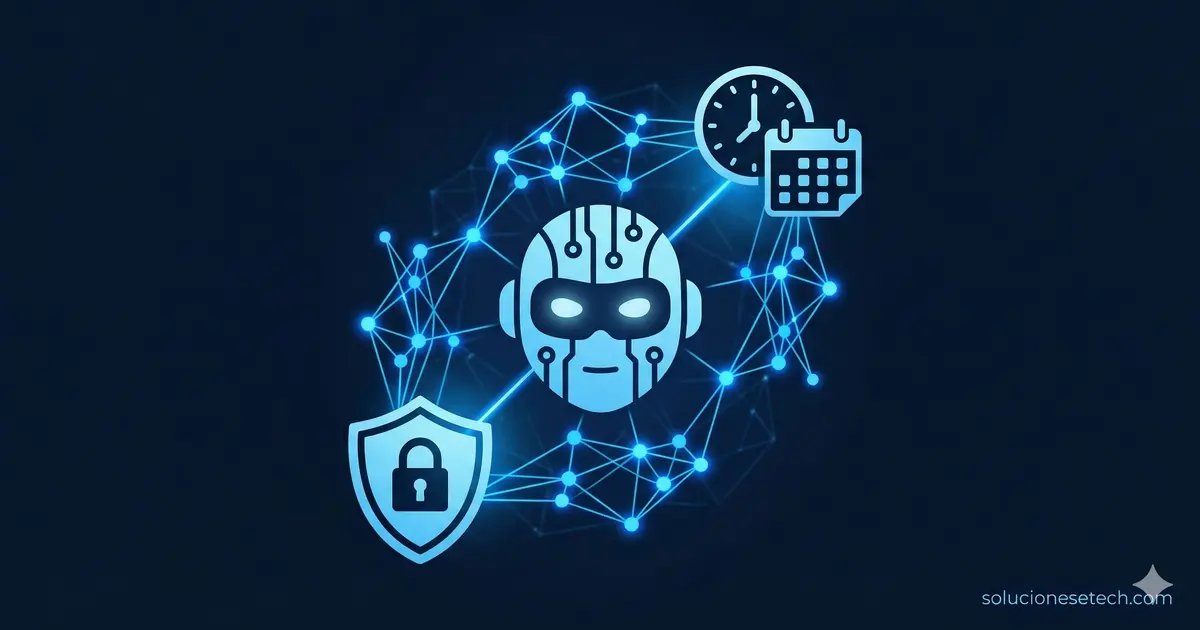
In February 2026, Abacus AI released Secure OpenClaw — a secure runtime environment for their DeepAgent platform. The concept is straightforward: AI agents that don't stop working when you close the browser. Agents that retain memory across sessions, execute tasks on schedules, and interact with your internal systems continuously.
This is not a smarter chatbot. This is a persistent process that can respond to emails, schedule meetings, browse the web, connect to databases, and execute complete workflows — without a human triggering each step.
The critical shift is persistence. A traditional chatbot has no memory of yesterday's conversation. A persistent agent remembers your preferences, the context of ongoing projects, and decisions made last week. That memory fundamentally changes what AI can do in a business context.
DeepAgent can even be deployed to Telegram for personal productivity workflows — a small detail that signals where this technology is heading: always on, always available, integrated into the tools people already use.
Why security is the make-or-break factor
Anyone can build an AI agent with open-source tools today. The technical capability is not the bottleneck — trust is. Would you give unsupervised access to your corporate email, CRM, and internal databases to a process that executes code autonomously?
This is where Secure OpenClaw addresses the right problem. The environment carries SOC 2 Type 2 certification, encryption at rest and in transit, granular access controls, and isolation between agents. In practical terms, it's the difference between running a script on someone's laptop and executing a process inside an audited enterprise environment.
For organizations already working with technology consulting services, this type of architectural decision is familiar territory: the technology exists, but the execution environment determines whether it can be used in production or only in a sandbox.
That said, no certification eliminates risk entirely. SOC 2 Type 2 means the controls were audited and functioning during the evaluation period. It does not mean they are impenetrable. Companies must conduct their own risk assessment before connecting autonomous agents to critical systems.
The pricing signal you should not ignore
DeepAgent starts at $10 per month at its base tier.
Compare that to the fully loaded cost of an administrative employee anywhere in the Americas — salary, benefits, office space, tools, management overhead — and $10 per month for an agent that works 24/7 without breaks completely changes the economics of certain operations.
I am not arguing that these agents replace people. But they redistribute work. Repetitive, predictable, rule-based tasks — responding to standard emails, classifying documents, updating records, generating periodic reports — are natural candidates for persistent agent automation.
The low price point also signals something more important: the barrier to adoption is no longer financial. A mid-market company can test this technology without a special budget approval cycle. That accelerates adoption in ways that traditional enterprise tools never could.
Three implications for business leaders
1. Automation shifts from project to capability
Until now, process automation required integration projects with multi-month timelines and significant budgets. Persistent agents compress that cycle. If an agent can connect to your email, calendar, and ticketing system with minimal configuration, automation becomes an operational decision rather than an IT project.
Organizations already investing in AI and automation services can scale faster. Those that haven't started now have a more accessible entry point — but they also have less time before competitors figure it out.
2. AI vendor evaluation looks completely different
When AI was a chat interface, evaluating vendors was relatively simple: response quality, speed, cost per token. With persistent agents, the evaluation resembles procuring critical infrastructure. You need to assess:
- Runtime security: What certifications does the environment hold? How is tenant isolation implemented?
- Data persistence: Where is the agent's memory stored? Who has access? What happens when you terminate the agent?
- Access controls: Can you restrict what the agent does inside your systems at a granular level?
- Audit trails: Are there detailed logs of every action the agent executed?
- Service continuity: What happens during a provider outage? Are scheduled tasks lost or queued?
This level of diligence is what separates organizations that adopt AI responsibly from those that connect tools without considering the consequences.
3. The IT team's role evolves from operator to supervisor
When AI agents handle operational tasks, the IT team doesn't disappear — it changes function. Instead of executing processes, they supervise agents. Instead of responding to repetitive tickets, they define the rules agents operate under and monitor for exceptions.
This requires new skills: prompt engineering, agent workflow design, automation risk assessment, and autonomous behavior monitoring. Companies that invest in training their teams for this supervisory role will extract significantly more value from the technology than those that simply deploy agents and hope for the best.
How to assess whether your organization is ready
Before activating a persistent agent connected to your systems, ask these questions:
Are your processes documented? An agent can only automate what is defined. If your processes exist only in employees' heads, the first step is documentation — not automation.
Are your access controls clear? If you don't know exactly who has access to what systems today, giving access to an autonomous agent multiplies your risk. Fix your permissions first.
Do you have monitoring capability? An agent operating without supervision needs logs, alerts, and emergency stop mechanisms. If you lack visibility into your current systems, adding an autonomous agent makes the problem worse.
Do you have a clear use case? The temptation is to automate everything. The reality is that initial agents should be deployed on low-risk tasks with measurable outcomes. Automated responses to frequently asked questions, scheduled report generation, or incoming document classification are solid starting points.
Where this is heading
The transition from "AI as a chat tool" to "AI as a persistent digital worker" is the most significant evolution since large language models became commercially available. Not because the technology is perfect — it isn't — but because it fundamentally changes the relationship between businesses and automation.
Secure OpenClaw is one implementation of this trend. There will be others. Microsoft, Google, and Amazon are all building agent frameworks. What matters is not the individual product but the pattern: autonomous agents that are secure, persistent, and economically accessible.
The companies that understand this pattern and prepare their infrastructure, governance, and teams for it will operate at a level of efficiency that manual-only competitors cannot match. The companies that dismiss persistent agents as "just another AI product" will find themselves competing against organizations that never sleep, never forget, and cost $10 a month per workflow.
The question is not whether persistent AI agents will reach your industry. The question is whether you will be deploying them or competing against them.
Frequently asked questions
What is the difference between a persistent AI agent and a traditional chatbot?
A traditional chatbot responds to questions in isolated sessions — each conversation starts from zero with no memory of previous interactions. A persistent AI agent like DeepAgent maintains memory across sessions, executes tasks on defined schedules, connects to internal systems, and operates continuously without requiring a user to activate it each time. It is the difference between a consultation tool and an autonomous process that works in the background on your behalf.
Is it safe to connect an autonomous AI agent to my company's internal systems?
Safety depends on the execution environment and the controls you implement. Platforms like Secure OpenClaw provide SOC 2 Type 2 certification, encryption, and agent isolation. However, no certification eliminates risk completely. Before connecting an agent to critical systems, ensure you have granular access controls, detailed audit logs, emergency stop mechanisms, and a low-risk use case for the initial deployment. A phased approach starting with non-critical workflows is strongly recommended.
Where should my organization start with persistent AI agents?
Start by documenting your repetitive, predictable processes. Identify low-risk tasks with measurable outcomes — such as automated responses to common inquiries, scheduled report generation, or document classification. Ensure your access controls and monitoring capabilities are in place before deploying any agent. If you need help evaluating your operational readiness, a technology consulting engagement can provide a structured assessment and implementation roadmap.